Workplace Injuries in Italy with a Musculoskeletal Focus
An in-depth analysis of official 2024 data published by INAIL, the Italian National Institute for Insurance against Accidents at Work: 514,517 reported injuries, 88,384 occupational diseases and an economic estimate of the cost of musculoskeletal disorders for public institutions and employers.
Note: this study is based on official Italian INAIL data and refers to the Italian labor market.

The 2024 picture at a glance
Reported injuries in 2024 (-0.9% vs. 2023)
Reported fatal cases (stable)
Occupational diseases (+21.8%)
Musculoskeletal disorders (ICD-10 M00-M99)
In 2024 workplace injuries dropped to 413,517 (-1.9%), while commuting injuries rose to 101,000 (+3.1%). The "outside the workplace" component continues to grow: 22.8% of all injuries and 42.3% of fatalities. The reported rate is 1,728 cases per 100,000 workers and 3.70 fatalities per 100,000 workers.
On the occupational disease side, the musculoskeletal focus is even sharper: disorders of the musculoskeletal system and connective tissue (ICD-10 M00-M99) account for roughly 3 out of 4 cases. Construction (29%) and Manufacturing (26%) together represent more than half of all claims.
2020-2024 time series
2024 figures remain below pre-pandemic 2019 levels: reported injuries -8.5% and fatalities -3.9%. Commuting injuries, however, keep growing structurally.
| Year | Reported injuries | Workplace | Commuting | Fatalities |
|---|---|---|---|---|
| 2020 | 547,903 | 482,775 | 65,128 | 1,735 |
| 2021 | 522,617 | 439,188 | 83,429 | 1,461 |
| 2022 | 640,239 | 546,764 | 93,475 | 1,289 |
| 2023 | 519,472 | 421,533 | 97,939 | 1,193 |
| 2024 | 514,517 | 413,517 | 101,000 | 1,189 |

Sector distribution (2024)
Injuries are heavily concentrated in sectors with high musculoskeletal exposure: manual handling, awkward postures and repetitive efforts.
Average days of disability by impairment class
The duration of absence grows almost monotonically with residual permanent impairment. The pattern is consistent with a heavy musculoskeletal burden.
The cost of musculoskeletal disorders
Annual direct cost attributable to INAIL
Based on INAIL's 2024 financial statements (€5.516 bn in economic benefits) and attribution rates for musculoskeletal cases, the per-scenario estimate is:
Cost for the employer
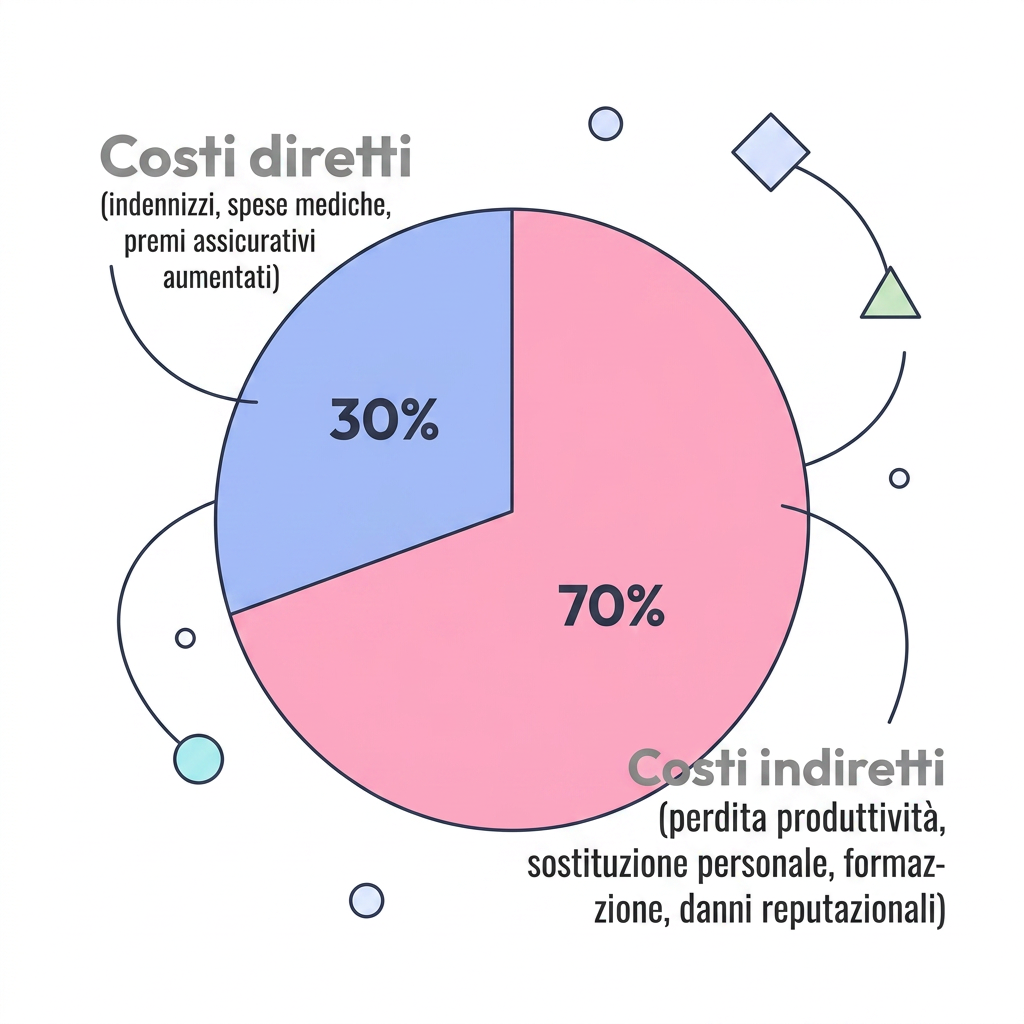
Even when public insurance absorbs the largest share, the employer bears significant direct and indirect costs: first days of absence, replacement, training, overtime, loss of productivity and presenteeism.
| Scenario | Direct cost / case | Indirect cost / case | Total per case | Total for employers |
|---|---|---|---|---|
| Optimistic | €770 | €1,070 | €1,840 | €279 M |
| Central | €1,416 | €2,764 | €4,180 | €790 M |
| Conservative | €2,376 | €5,490 | €7,866 | €1.824 bn |
Annual cost range per scenario (€ millions)
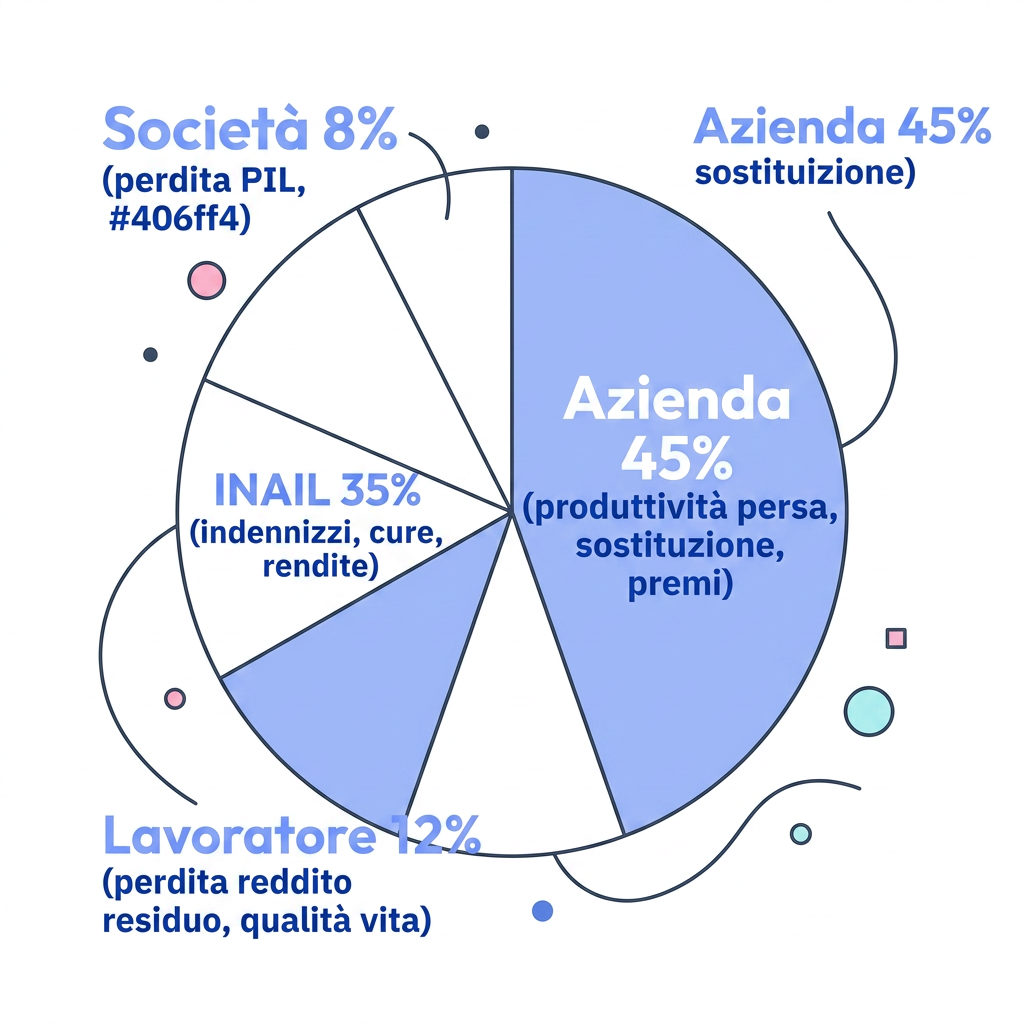
Logistics worker with acute low-back pain (45 days)
INAIL side
Average daily temporary cost: €59.1/day
45 days × 59.1 = €2,660
+ healthcare and rehabilitation share: €650
Total: ~€3,310
Employer side
Direct cost: €1,416
Indirect cost: €2,764
Total for employer: €4,180
Five priorities for prevention
1. Priority sectors
Manufacturing, Construction, Transport & logistics, Healthcare & social care, Retail & large-scale distribution.
2. Risk assessment
Standardized tools (NIOSH, OCRA, REBA) for biomechanical overload.
3. Data and prevention
Integrated use of INAIL and SINP datasets to flag companies with early signals of M00-M99 disorders.
4. Return to work
Early rehabilitation and task adaptation to reduce lost days.
5. Safe mobility
Measures on commuting and task rotation, given the rise of in-itinere injuries.
Safe Plate System
A targeted solution that supports the wiring of rear panels, reducing awkward postures and repetitive efforts.
Sources and links
- INAIL annual report 2024 and graphic annexes (Italian)
- INAIL open data — monthly and semestral datasets
- INAIL national tables — line B7.1.1 (average days of disability)
- INAIL occupational disease tables, MM block — line MM7 (M00-M99)
- INAIL data — first 2024 balance
- INAIL guide "Work-related musculoskeletal disorders" (PDF, Italian)
- Eurostat — European occupational diseases statistics
- Eurostat — Accidents at work statistics
Methodological note: the economic estimates are share-based attributions starting from INAIL's official aggregated accounts and from Eurostat benchmarks. They are not official disaggregated accounting figures by injury type, because INAIL does not publish a profit-and-loss statement for "musculoskeletal cases". All figures refer to the Italian labor market.